

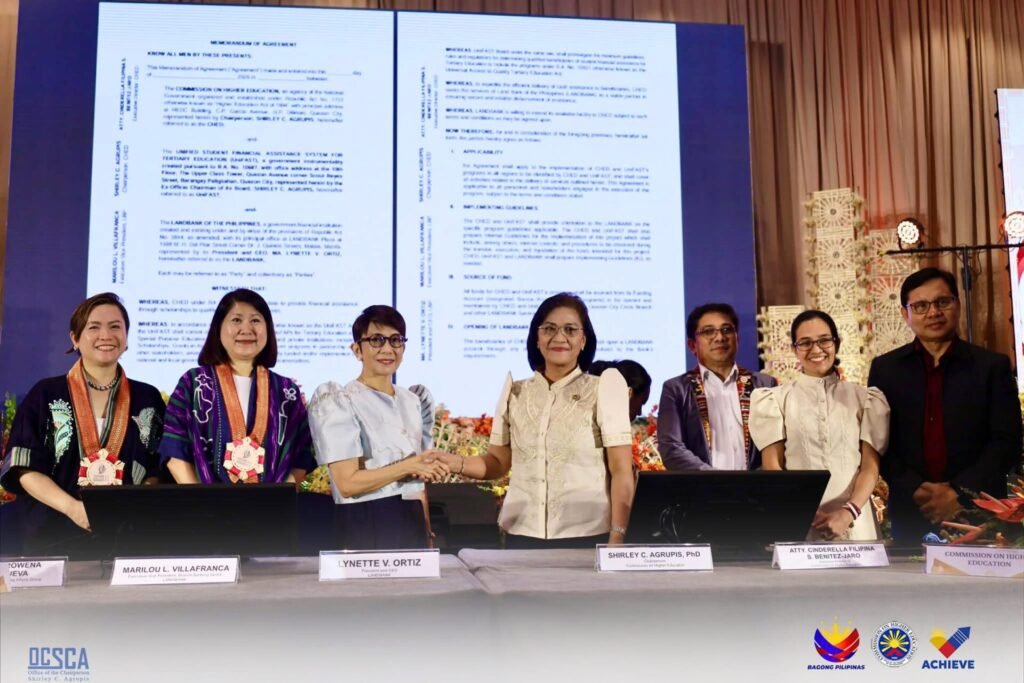
CLARK FREEPORT ZONE — The Commission on Higher Education (CHED) and Land Bank of the Philippines (LANDBANK) signed two landmark agreements to modernize agriculture-related higher education and streamline student financial assistance.
Held during the third and final day of the Higher Education Summit 2026 in Clark, a Memorandum of Agreement (MOA) was inked for the “Cultivating the Future: Modernizing Philippine Agriculture and Higher Education through CHED-LANDBANK Synergy” program which aims to strengthen state universities and colleges in climate-smart research, food security, and workforce development in the agricultural sector.
“The MOA ensures that student scholarships and subsidies under the Unified Student Financial Assistance System for Tertiary Education and other CHED programs are delivered efficiently and inclusively, giving students access to bank accounts and digital financial services,” LANDBANK President and Chief Executive Officer Ma. Lynette Ortiz said.
It covers financial inclusion and scholarship disbursement modernization, aiming for a secure, timely, and transparent system to support student beneficiaries nationwide.

Meanwhile, the signed Memorandum of Understanding (MOU) outlines broader collaboration, including agri-entrepreneurship and technology business incubators, expansion of LANDBANK scholarship programs, climate-smart research development, career development, and workforce integration for graduates in agriculture-related fields.
Ortiz stressed that the partnership reflects a whole-of-government approach, linking higher education with national development priorities and the agricultural value chain.
Meanwhile, CHED Chairperson Shirley Agrupis highlighted the accelerated implementation of the agreement, calling it the fastest MOA she has witnessed in her nine months as chair of the commission.
“This convergence ensures that scholarships and government support reach students efficiently, while aligning higher education with agricultural development priorities,” she said.
The collaboration prioritizes agriculture and fisheries, in line with the Presidential Bagong Pilipinas Scholarship Program, which allocates 20,000 slots for students in these sectors.
“Through this, we strengthen pathways for innovation, entrepreneurship, and workforce development in agriculture. This also aligns with the CHED ACHIEVE reform agenda, particularly our efforts to strengthen the Sustainable Development Goals-aligned research and innovation, advance human capital development in priority sectors, and ensure that higher education institutions remain responsive to the country’s long-term development priorities,” Agrupis noted.
Through the MOA and MOU, state universities and colleges and private higher education institutions will enhance teaching, research, and extension programs to modernize the agriculture sector and develop future-ready professionals.
Ortiz noted that LANDBANK’s mandate to empower Filipinos, particularly in agriculture, will be strengthened through digital platforms and financial inclusion programs.
Together, both parties said the two agreements mark a milestone in integrating higher education, financial services, and national development objectives, ensuring that graduates are equipped to contribute meaningfully to sustainable agriculture and rural development.
—