


Bonifacio Global City (BGC) is entering a more inclusive and transit-anchored phase of growth as major infrastructure projects converge with long-term urban planning reforms under the national development agenda of President Ferdinand R. Marcos Jr.
At the center of this shift is the Metro Manila Subway, one of the Marcos administration’s flagship transport initiatives being implemented by the Department of Transportation (DOTr). The DOTr is leading the subway’s construction and coordination across national and local agencies, positioning it as the backbone of a more integrated mass transit system for Metro Manila.
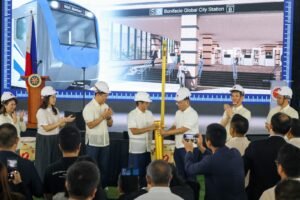
President Marcos Jr. last week led the groundbreaking of the 1.33-kilometer segment connecting Shaw Boulevard Station in Pasig City to Lawton Avenue Station in Taguig City, including stations within Uptown Bonifacio Global City. With planned stops near Kalayaan Avenue and the eastern portion of BGC, the district is set to gain direct underground rail access to Ninoy Aquino International Airport and major hubs in Quezon City in under 30 minutes.
The subway will feature seamless interconnections with existing and planned railway lines, including Light Rail Transit (LRT) Line 1, Metro Rail Transit (MRT) Line 3, MRT-7, LRT-2, MRT-4, and the North-South Commuter Railway, strengthening Metro Manila’s linkages with nearby provinces.
For the Bases Conversion and Development Authority (BCDA), which oversees BGC, the subway addresses the district’s long-standing reliance on private vehicles and creates the foundation for stronger transit-oriented development.
“National infrastructure investments are allowing BGC to mature into a more commuter-focused and accessible district,” said BCDA President and CEO Engr. Joshua M. Bingcang. “When mass transit becomes embedded in the estate, it improves mobility, strengthens property fundamentals, and supports long-term competitiveness.”
Improved rail access is expected to increase pedestrian activity within walking distance of future stations, benefiting residential condominiums, office developments, and retail corridors along BGC.
People-centric redevelopment
Parallel to rail development, strategic redevelopment is reshaping key areas of the district. The former Fort Strip property along 5th Avenue in BGC is being repositioned for higher-density, mixed-use development aligned with the district’s next-stage urban model. This enabled the opening of a new 7th Avenue road segment toward 32nd Street, restoring continuity to the district’s street grid and improving mobility between Uptown and High Street.
These projects are reinforced by a broader and more people-centric recalibration of BGC’s master plan. BCDA, in partnership with SyCip Gorres Velayo & Co., is currently refreshing the BGC Master Development Plan, aligning land use with upcoming transport infrastructure, enhancing walkability, expanding green spaces, and integrating smart systems for traffic and utilities management.
This is also linked to BCDA’s national push for model transit-oriented developments. The BCDA has partnered with the Japan International Cooperation Agency (JICA) and coordinated with relevant government agencies to develop a roadmap for transit-oriented development (TOD) in the Philippines. The collaboration aims to align land use planning, infrastructure investment, and value capture mechanisms around major rail corridors.
Under this framework, BGC serves as a practical example of how infrastructure and land management can be synchronized. By clustering residential, commercial, and civic spaces around transit nodes, density is supported by mobility rather than road expansion. This approach reduces congestion pressure while improving daily accessibility.
Industry assessments continue to identify BGC as one of Metro Manila’s most resilient submarkets, supported by steady tenant demand and established infrastructure. The integration of subway connectivity, redevelopment initiatives, and TOD-based planning positions the district for sustained growth grounded in accessibility and urban efficiency.
“With infrastructure aligned to land use and guided by a clear transit-oriented framework, BGC is moving into a more inclusive phase of growth,” Engr. Bingcang said. “Accessibility is no longer a constraint. It becomes a driver of long-term value.”
BCDA noted that lessons from BGC’s evolution will inform similar strategies in other growth centers such as New Clark City, as the agency advances a broader model of sustainable and people-centered urban development across its economic zones.